











Se Habla Espanol
Our Blog
Stark Law Whistleblowers Expose Hospital Fraud and Recover Millions
On April 2, 2026, the Department of Justice announced that Trinity Hospital Holding Company (Trinity), which operates a hospital in Steubenville, Ohio, has agreed to pay $1.7 million to resolve allegations that it maintained improper financial relationships with two referring physicians. According to the allegations, from 2014 through 2020, Trinity made improper financial contributions to two referring physicians in the form of rental arrangements for office space that exceeded fair market value, thus violating the Stark Law.
Trinity self-disclosed these arrangements to the government following an independent investigation and took action to remedy the misconduct. Trinity received credit for this cooperation with the government, thereby avoiding potentially much steeper fines.
What is the Stark Law?
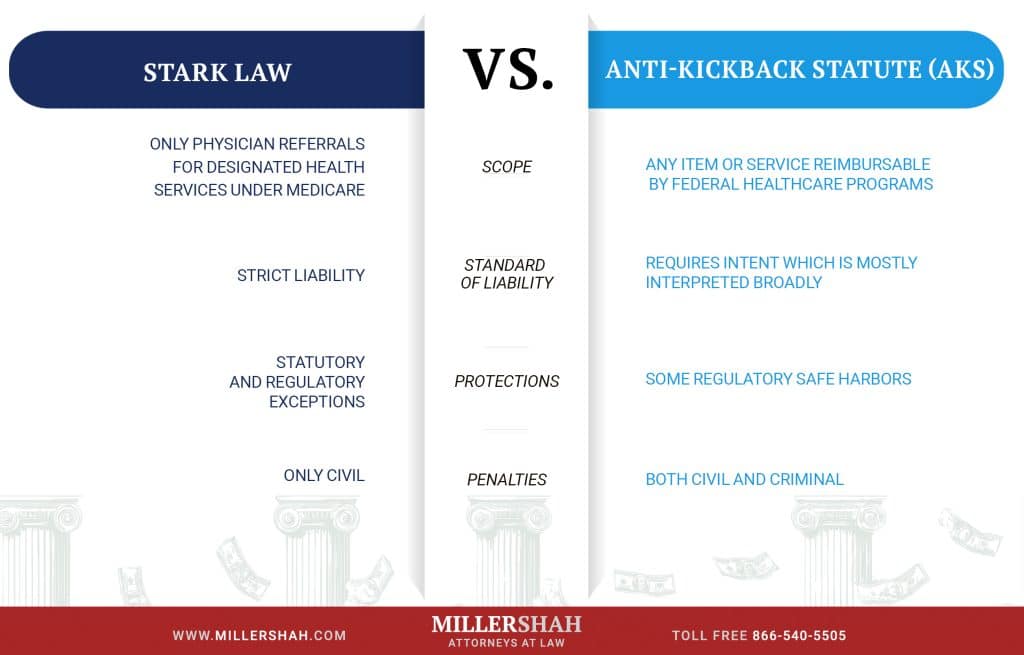
Section 1877 of the Social Security Act, more commonly known as the Stark Law or physician self-referral law, prohibits a physician from making referrals for certain designated health services payable by Medicare to an entity where the physician or their immediate family member has a financial relationship and prohibits the entity from filing claims with Medicare for any improperly referred designated health services.
Designated health services covered under the Stark Law include:
- Clinical laboratory services
- Physical therapy services
- Occupational therapy services
- Outpatient speech-language pathology services
- Radiology and certain other imaging services
- Radiation therapy services and supplies
- Durable medical equipment and supplies
- Parenteral and enteral nutrients, equipment, and supplies
- Prosthetics, orthotics, and prosthetic devices and supplies
- Home health services
- Outpatient prescription drugs
- Inpatient and outpatient hospital services
The Stark Law defines “financial relationship” as an ownership or investment interest in the entity or a compensation arrangement with the entity. However, there are several specific exceptions for financial relationships that do not violate the Stark law, and the Secretary of the Department of Health and Human Services has the authority to create new exceptions for financial relationships which do not pose a risk of program or patient abuse. Exceptions often involve legitimacy guarantees such as fair market value considerations, proper documentation, or bona fide employment relationships.
What is the Anti-Kickback Statute?
Another important law that regulates payments to healthcare providers is the Anti-Kickback Statute (AKS). The AKS is a criminal law that prohibits the knowing and willful payment of remuneration to induce or reward patient referrals for any item or service payable by federal healthcare programs. “Remuneration” is broadly defined to include anything of value, not just cash or in-kind payments. This expansive definition includes non-monetary and even indirect benefits, such as:
- Free or discounted services, like billing support or medical directorships
- Free or discounted items, like diagnostic devices or office space
- Special deals, discounts, or rebates, such as on referral or purchasing volume
- Travel, meals, entertainment, or perks, like luxury dinning and hotel stays
- Intangible economic benefits, such as marketing services or infrastructure support
- Patient-facing benefits, including routine waiver of copays or charitable subsidies for drugs or treatments
While this broad understanding applies in most courts across the country, there is one outlier decision: In 2023, the Court of Appeals for the Sixth Circuit held that “renumeration” under the AKS includes only payments or other transfers of value, thereby adopting a narrower interpretation of the statute. However, this interpretation has not gained traction in other Circuits.
Like the Stark Law, there are certain “safe harbors” under the AKS, established by the Department of Health and Human Services Office of the Inspector General. These safe harbors protect certain payment and business practices from criminal liability. Generally, to fall under an AKS safe harbor, a practice must include written and signed agreements for services, compensation set in advance and at fair market value, and must not consider the volume or value of patient referrals.
Stark Law vs. Anti-Kickback Statute
Reporting Stark Law Violations
There are two ways to report Stark Law violations: through the Voluntary Self-Referral Protocol and the qui tam provision of the False Claims Act (FCA). The Voluntary Self-Referral Protocol is an instrument through the Center for Medicare & Medicaid Services that allows health care providers to submit information on actual or potential violations of Stark Law. Additionally, because Medicare claims submitted pursuant to a Stark Law violation are considered “false” under the FCA, whistleblowers can file qui tam lawsuits for violations of Stark Law.
While the AKS is more frequently in the headlines, there have been several large Stark Law whistleblower cases in recent years. Some notable cases are United States ex rel. Bookwalter v. UPMC and United States ex rel. Fischer v. Community Health Network, Inc. In Bookwalter, originally filed in the United States District Court for the Western District of Pennsylvania, the whistleblowers alleged that the University of Pittsburg Medical Center (UPMC) paid productivity-based compensation to neurosurgeons in exchange for referrals. UPMC agreed to pay $38 million to resolve the allegations in May of 2024. In the Fischer, originally filed in the United States District Court for the Southern District of Indiana, the government alleged that senior management at Community Health Network (CHN) illegally recruited physicians by paying them salaries that were significantly higher than what they were receiving in their own private practice for the purpose of capturing their lucrative “downstream referrals.” CHN agreed to pay the United States $345 million to resolve claims in December 2023.
If you have knowledge of a physician referral arrangement which you suspect violates the Stark Law, contact Miller Shah for a free consultation.
Contact
Miller Shah LLP
While this website provides general information, it does not constitute legal advice. The best way to get guidance on your specific legal issue is to contact a lawyer. To schedule a meeting with an attorney, please call 866-540-5505 or complete the intake form to email us. To inquire about employment opportunities with Miller Shah LLP, please see our Opportunities page.
NJ Collingswood
900 Haddon Avenue, Suite 304-8
Collingswood, NJ 08108

866-300-7367
Fax number
866-540-5505
Telephone
Attorney Advertising. This information is designed for general information only. The information presented should not be construed to be formal legal advice nor the formation of a lawyer/client relationship. Past results and testimonials are not a guarantee, warranty, or prediction of the outcome of your case, and should not be construed as such. Past results cannot guarantee future performance. Any result in a single case is not meant to create an expectation of similar results in future matters because each case involves many different factors, therefore, results will differ on a case-by-case basis. By providing contact information, users acknowledge and give explicit consent to be contacted via the methods of communication provided, including SMS. Message and data rates may apply. Message frequency may vary. Reply STOP to opt out.
NUVEW | Copyright 2026 All Rights Reserved | Accessibility Notice | Privacy Policy
Alden Hey - Project Analyst
PA Philadelphia | 866-540-5505
Alec J. Berin - Partners
PA Philadelphia | 866-540-5505
Alfonso Vilaboa - Partners
NY New York City | 866-540-5505
Ana Barba - Project Analyst
NY New York City | 866-540-5505
Anika S. Keuning - Project Analyst
NY New York City | 866-540-5505
Anna D’Agostino - Associate
NY New York City | 866-540-5505
Arman Borghei - Law Clerk
PA Philadelphia | 866-540-5505
Bruce D. Parke - Partners
PA Philadelphia | 866-540-5505
Cameron Smith - Project Analyst
PA Philadelphia | 866-540-5505
Caroline Soper - Project Analyst
NY New York City | 866-540-5505
Catalina Rey - Of Counsel
FL Miami | 866-540-5505
Christopher A. Miller - Associate
PA Philadelphia | 866-540-5505
Deborah C. England - Of Counsel
CA San Francisco | 866-540-5505
Elise M. Wilson - Law Clerk
NY New York City | 866-540-5505
Emily Aikens - Project Analyst
NY New York City | 866-540-5505
Eric L. Young - Of Counsel
PA Philadelphia | 866-540-5505
Faaria Zubair - Project Analyst
NY New York City | 866-540-5505
Gina S. Demetriades - Office Staff
CT Chester | 866-540-5505
Heidi A. Wendel - Of Counsel
NY New York City | 866-540-5505
Henry Fina - Project Analyst
PA Philadelphia | 866-540-5505
Ian S. Lam - Associate
PA Philadelphia | 866-540-5505
Isack Fadlon - Of Counsel
CA Los Angeles | 866-540-5505
James C. Shah - Partners
CA Los Angeles | 866-540-5505
James E. Miller - Partners
CT Chester | 866-540-5505
Jasmine Roman - Office Staff
CT Chester | 866-540-5505
Jayne A. Goldstein - Partners
FL Miami | 866-540-5505
Jillian M. Lussier - Office Staff
CT Chester | 866-540-5505
Jocelyn McNamara - Law Clerk
NY New York City | 866-540-5505
Johanna C. Richter - Law Clerk
PA Philadelphia | 866-540-5505
Jonathan A. Dilger - Office Staff
NY New York City | 866-540-5505
Katherine W. Frederick - Office Staff
CA Los Angeles | 866-540-5505
Katie Canfield - Legal Assistant
PA Philadelphia | 866-540-5505
Kolin C. Tang - Partners
CA Orange County | 866-540-5505
Kyla Golding - Project Analyst
PA Philadelphia | 866-540-5505
Laurie Rubinow - Partners
CT Chester | 866-540-5505
Leanne Alvarado - Project Analyst
NY New York City | 866-540-5505
Madison A. Gregg - Associate
NY New York City | 866-540-5505
Mark Xiao - Associate
NY New York City | 866-540-5505
Matthew P. Suzor - Associate
PA Philadelphia | 866-540-5505
Natalie Finkelman Bennett - Partners
PA Philadelphia | 866-540-5505
Nathan C. Zipperian - Partners
FL Miami | 866-540-5505
Nicholas Day - Of Counsel
NJ Collingswood | 866-540-5505
Nicholas K. Ono - Law Clerk
NY New York City | 866-540-5505
Nicole Jefferson - Project Analyst
PA Philadelphia | 866-540-5505
Shuping Li - Law Clerk
NY New York City | 866-540-5505
Stephen T. Rutkowski - Law Clerk
PA Philadelphia | 866-540-5505
Sue Moss - Legal Assistant
PA Philadelphia | 866-540-5505
Sydney D. Finlay - Associate
CA San Diego | 866-540-5505
Talia Chang - Project Analyst
PA Philadelphia | 866-540-5505
Tara Gideon - Office Staff
PA Philadelphia | 866-540-5505
Tina Moukoulis - Staff Attorney
PA Philadelphia | 866-540-5505
Tracy Feldman - Office Staff
PA Philadelphia | 866-540-5505
Zacky P. Rozio - Of Counsel
CA Los Angeles | 310-203-0600